
School feeding is often seen as a nice-to-have. In reality, it is a strategic investment. In Côte d’Ivoire, expanding school meals could simultaneously improve education outcomes, nutrition, social protection, and rural livelihoods.
Through the CLEF initiative—a partnership between the Government of Côte d’Ivoire, 16 cocoa and chocolate companies, and two philanthropic foundations—the Ministry of National Education is testing a model aimed at making school feeding both sustainable and scalable nationwide.
Today, meals are served for an average of 33 days per year in just 36% of primary schools.
What will it take to turn this into a nationwide system that reaches every child?
Explore the article.
In Côte d’Ivoire, school meals remain a privilege for a minority of students. According to data from the Ministry of National Education, Literacy and Technical Education, only 36% of primary schools currently have a functioning, state-supported canteen. In other words, nearly two out of three schools do not offer regular meals to their pupils. And even when there are canteens, food supplies only provide meals for an average of just 33 days out of the 120 days that make up the school year.
“There is a shortfall in school canteens coverage, and the number of operating days is still insufficient, despite the efforts made by the government and its partners,” acknowledges Jérôme Ayékoé, Director of School Canteens at the Ministry of National Education, Literacy and Technical Education. On the ground, the needs remain considerable. Yet within the corridors of the ministry and among its international partners, one word now comes up repeatedly: priority.
“The government takes school feeding very seriously; it has truly become a national priority,” says Séverine Giroud, Deputy Country Director and Head of Programs at the World Food Program (WFP) in Côte d’Ivoire. This political commitment is gradually translating into concrete results. Authorities point to a steady increase in food supplies in recent years. As a result, the number of days when canteens operate has risen from 18 days during the 2020–2021 school year to 33 days in the current school year, notes Jérôme Ayékoé.
For those working in the sector, however, the issue goes far beyond the simple matter of a meal. “School feeding is not just a meal. It is a multisectoral lever that improves education, nutrition, social protection and local economies,” explains Séverine Giroud.
In fact, the effects can quickly be seen in schools. Having a canteen improves attendance and academic performance, reduces dropouts and directly relieves the financial pressure on the most vulnerable households by lowering their food expenses. It also acts as a powerful incentive for schooling, helping to curb child labor and early marriage.
In many rural families, every meal counts. When a child eats at school, that is one meal less the family needs to provide at home. It may seem like a small detail, but it weighs heavily on household budgets that are already fragile—and can sometimes make the difference between a child staying in school or leaving it.
Testing a sustainable and scalable model
Feeding children, supporting communities
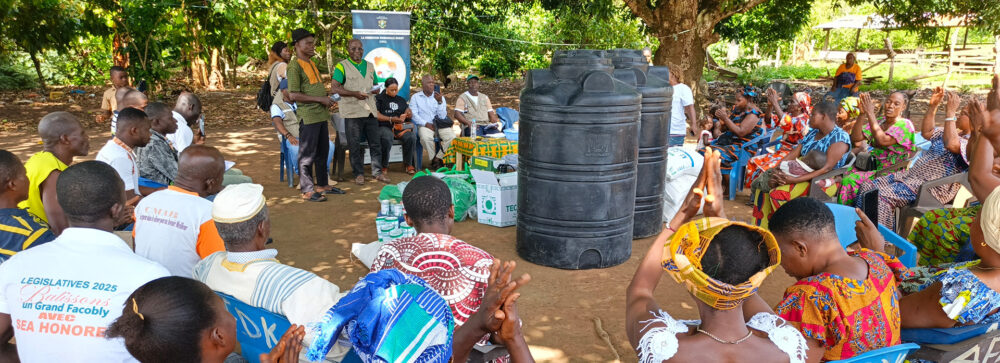
Behind this community contribution lies a mechanism which is central to the project: anchoring school feeding in the local economy. Alongside the Directorate of School Canteens, the National Agency for Rural Development Support (ANADER) works with local producers—organized into cooperatives largely composed of women—to supply food to school canteens. The idea is simple: the more farmers improve their yields and incomes, the better they can sustainably support school feeding.
To make this possible, ANADER trains around a hundred producer groups in agricultural techniques, food and nutrition security, and provides inputs and small-scale farming equipment. The objective is twofold: to increase agricultural productivity while securing the supply of food for school canteens.
For Issoufou Dosso, the agency’s Regional Director for the West, the benefits go far beyond the school setting. “Each harvest that is shared feeds children and strengthens communities. By improving their production, these groups can support school canteens more broadly while also strengthening their own incomes.”
Gradually, a local dynamic is taking shape: farmers that are more productive, better-supplied school canteens and better-nourished children – who are more attentive and present in the classroom. For the CLEF coalition, the logic is clear: investing in school feeding also means investing in local agriculture, in the incomes of rural families and, ultimately, in the future of children.
CLEF is a commitment to:
- Get more children into school.
- Make sure children learn at school.
- Achieve impact at scale; we want to make a difference in the lives of more than 4 million children by 2027.
CLEF funds school infrastructure and childcare facilities, supports teacher training in evidence-based pedagogical techniques, promotes behavior change so parents engage in their children’s education and apply good parenting practices to boost early childhood development, and tests a cutting-edge school nutrition program.
CLEF welcomes new partners: contact us to learn more about the initiative and to get involved.